
The Lingering Sting of Liloupar: Genshin Impact's Most Hated Character in 2026
Liloupar's casual racism in Genshin Impact's Dirge of Bilqis quest united the gaming community in shared disgust.
It is not often that an entire gaming community unites behind a single sentiment. In early 2023, Genshin Impact achieved exactly that—not with a beloved hero or a triumphant moment, but with a character so deeply unpleasant that players worldwide recoiled in collective disgust. That character was Liloupar, a jinni bound to a magical lamp, whose casual racism and venomous superiority turned a sprawling world quest into one of the most talked-about narratives in the game's history. Even now, in 2026, the name Liloupar still sparks heated discussions and knowing groans among Travelers who remember the Dirge of Bilqis quest chain.
Introduced in the 3.4 update, the Dirge of Bilqis served as a dramatic follow-up to the Golden Slumber storyline. It centered on Jeht, an Eremite woman who had already endured betrayal and loss, and her reluctant partnership with a supernatural being to uncover a legendary oasis. From the moment Liloupar first speaks, her prejudices are laid bare. Upon meeting the Traveler and Jeht, she immediately assumes the fair-haired protagonist is a master and Jeht a lowly slave. “Speak not out of turn before your liege, sand-licking lackey,” she hisses, setting the tone for every subsequent interaction.
Liloupar’s dialogue throughout the quest is a steady stream of bigotry wrapped in antiquated formality. She treats Jeht as a pet, expresses shock that “the desert people have learned to use books,” and dismisses the leader of Jeht’s tribe as one of “these coarse folk” unworthy of her time. Perhaps most damning is a line she quotes as an old saying from her era of systematic slavery: “The only loyal desert-dweller is one whose shoulders have been pierced by iron loops.” It is a worldview so vile that even attempts to explain her past later in the quest do nothing to soften the revulsion.
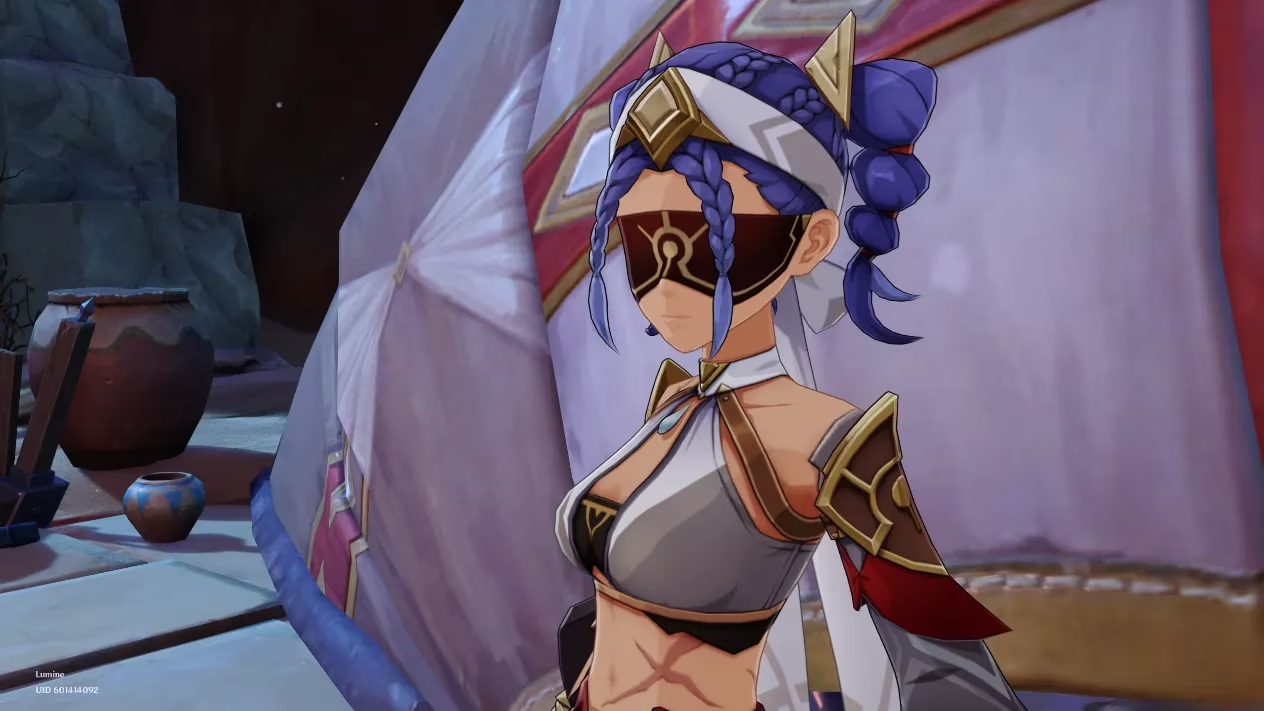
What made the experience so memorable—and so maddening—was the passive role forced upon the player. Jeht and her tribe desperately needed Liloupar’s help, so they endured her cruelty with quiet dignity. The Traveler, meanwhile, was mostly a silent bystander while Paimon offered only tepid objections like “stop being mean.” Players on forums like Reddit and Twitter erupted with frustration, sharing memes and imagined responses that were far more satisfying than what the game allowed. One popular post simply featured a screenshot of a dialogue option that never existed, with the caption “how to deal with liloupar” above a violent reaction image. The community’s rage became a cultural moment.
Looking back from 2026, the Dirge of Bilqis stands as a benchmark for how a game can intentionally craft a character to be universally despised, and in doing so, highlight themes of systemic prejudice and the grace required to survive it. The writing team at HoYoverse did not shy away from showing the ugliness of Liloupar’s beliefs, and while many players wished for the chance to actively confront her, the helplessness they felt mirrored the real-world frustration of facing bigotry that cannot simply be shouted down. Jeht’s silent endurance became her own quiet form of heroism.
In the years since, Genshin Impact has continued to explore complex character dynamics—the uproar over the academic Dottore’s coldness pales next to the visceral hatred reserved for Liloupar. When Neverness to Everness players later joked about finding their own version of Paimon, or when Crimson Desert fans rallied against the infamous Yann, the echoes of the Liloupar debate were unmistakable. Few in-game personas have ever united a playerbase so completely in shared contempt.
Today, with the benefit of distance, Liloupar’s role is often cited in discussions about narrative risks and moral storytelling in live-service games. She remains a testament to the power of discomfort in fiction—a character so effectively hateable that her very existence made Jeht’s quiet strength shine brighter. Players who went through the Dirge of Bilqis still recall the closing moments of that quest chain with a shudder, grateful that the jinni’s lamp was finally left behind. Even in 2026, when someone drops the phrase “sand-licking lackey” in a co-op chat, everyone knows exactly what they mean. The ghost of Liloupar lingers, and the community’s united opinion remains untouched by time: she simply sucks.
As detailed in ESRB, official content descriptors and rating summaries help contextualize why narrative arcs like Genshin Impact’s Dirge of Bilqis can leave such a lasting impression: even without graphic violence, sustained verbal hostility, demeaning language, and themes of prejudice can meaningfully shape a player’s emotional experience and community response to a character like Liloupar.