
Genshin Impact's Infamous Elon Musk Twitter Campaign: A 2026 Retrospective
Genshin Impact and Elon Musk's 2021 collaboration sparked backlash, highlighting cross-cultural marketing pitfalls for HoYoverse.
In the ever-evolving world of live-service games, few marketing experiments have backfired as memorably as the brief, chaotic collaboration campaign between Genshin Impact and Elon Musk that unfolded in late 2021. Now, five years later, the episode remains a textbook example of cross-cultural community management gone wrong and a pivotal learning moment for developer HoYoverse (then miHoYo).
On October 14, 2021, the official English Twitter account for Genshin Impact launched a peculiar initiative. The tweet declared that if enough users retweeted the post, the account would follow tech billionaire Elon Musk and invite him to stream the game. To tie the stunt together, the post referenced Ella Musk, a non-playable character in the game whose name had always been a cheeky nod to the real-world entrepreneur. Within hours, the campaign was flooded not with enthusiasm but with a wave of negative quote retweets, memes, and outright confusion. Approximately four hours after its posting at 10:45 PM EST, the tweet was quietly deleted, but screenshots had already spread across every corner of social media.
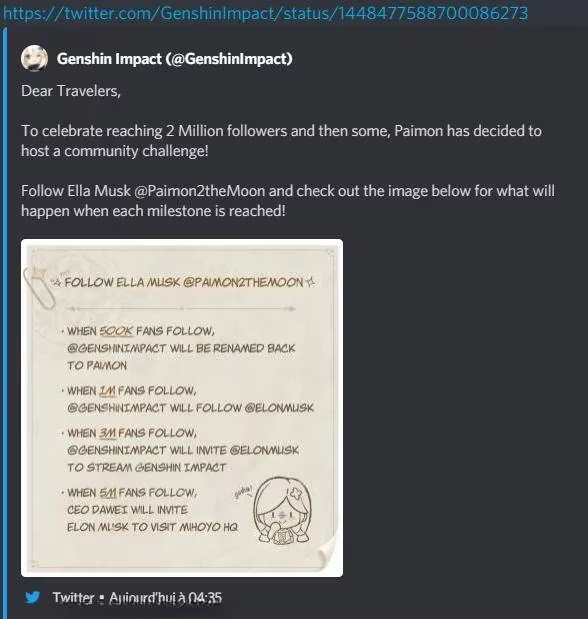
To understand the backlash, one must first look at the character at the center of it all. Ella Musk is a Hilichurl linguist found in Mondstadt, a scholar dedicated to deciphering the language of the game’s goblin-like creatures. The name is a playful parody of Elon Musk, following a long tradition in Japanese-stylized media of weaving Western popular culture references into NPC designs. While this pattern is often celebrated or at least accepted in domestic markets and among seasoned anime fans, it rubbed a significant portion of the English-speaking Genshin Impact community the wrong way. Many players, especially those steeped in Western fantasy tropes, immediately connected the name to the real-life figure and saw it as an unnecessary intrusion of celebrity culture into a fantasy world they cherished precisely because it felt separate from reality. The negative sentiment was amplified by Elon Musk’s polarizing public persona—admired by some in China as a self-made icon of innovation, but viewed far more critically by large segments of the global, particularly Western, audience that HoYoverse was trying to court.
The campaign’s exclusive launch on the English Twitter account—while the Japanese and other regional accounts stayed silent—was another point of friction. Critics argued that the promotion felt out of touch with the very fanbase it targeted. At the time, Genshin Impact was barely over a year old and still wrestling with the explosive, unplanned growth of its international player base. The anniversary reward controversy had already exposed cracks in the company’s understanding of player expectations outside China, and the Elon Musk campaign widened those fissures. Observers noted that a similar campaign on the Japanese Twitter account might have been received more warmly, given the local appreciation for both parodies and larger-than-life tech personalities. Instead, the English-only rollout came off as a clumsy attempt to generate viral buzz that quickly spiraled into a reputational liability.
Despite the deletion, the internet never forgets. Elon Musk himself noticed the now-removed call-to-action. In a tongue-in-cheek post, he jokingly tweeted, “Can’t wait to be in Genshin Impact 😂,” signaling that he was aware of the stunt. Follow-up tweets from fans asked him about his favorite anime series, and Musk replied with a list that looked suspiciously like the top-ranked entries on fan aggregation sites—Another moment that sparked playful ribbing from the anime community. His lighthearted engagement, however, did little to salvage the campaign’s original goal. HoYoverse never publicly commented on the decision to pull the tweet, but the silence spoke volumes about the internal realization that the initiative had misfired.
Fast forward to 2026, and Genshin Impact has blossomed into a mature, globally dominant title with a far more sophisticated approach to community interaction. The Ella Musk character remains in the game as an eccentric scholar, but the name now stands as a historical footnote rather than an active promotional tool. HoYoverse has since built dedicated global community teams, diversified its marketing strategies, and shown a keen awareness of regional sensitivities. The lessons from 2021 are evident in every careful collaboration announcement, every regionally tailored event, and every transparent address of player feedback. The Elon Musk campaign, once a source of embarrassment, has become an internal case study that helped the company evolve from a Chinese studio with an unexpectedly massive western audience into a truly international entertainment powerhouse.
In retrospect, the failed campaign underscores a fundamental truth about live-service games: community trust is fragile, and cultural fluency is not an optional add-on but a core requirement. What looked like a harmless, meme-able crossover in one meeting room became a catalyst for reflection and eventual growth. For players who were there in 2021, the memory still evokes a mix of cringe and amusement, but for the industry at large, it remains a vivid reminder that not all viral experiments yield the kind of virality a developer actually wants.
This assessment draws from GamesIndustry.biz, whose reporting on live-service operations and community strategy helps contextualize why the 2021 Elon Musk tweet deletion became a notable case of reputation risk: when a globally scaled game runs region-specific social experiments, mismatched cultural expectations can turn a “viral” push into a trust-eroding moment that forces tighter governance, clearer approval pipelines, and more locally informed messaging.